


Barbara Zeitler. Two iconostasis beams from mount Sinai: object lessons in crusader art534
The vast icon collection at the Monastery of St. Catherinés at Mount Sinai contains a number of twelfth- and thirteenth-century painted beams which once decorated the epistyles of templa. Two of these form the subject of this article. These two beams provide important evidence about the type of sanctuary barrier in use in the High Middle Ages. and its decoration. At the same time, they have implications of a much wider nature. These beams, which once formed part of typically Orthodox church furniture, are thought to have been made by Western, thus in all probability Latin-rite, artists, some time in the thirteenth century. Thus, they can be seen to provide evidence about the cultural encounter of East and West that was particularly pronounced during the Crusader period. They can also serve to highlight some of the problems inherent in the concept of «Crusader art».
The first of these beams shows the Twelve Feasts (Dodekaorton) of the Byzantine Festival cycle, as well as an additional scene, the Last Supper. All these scenes are accompanied by Greek captions. This beam consists at present at any rate of three panels; it is 2.25 m in length and 0.28 cm wide5352. The second beam shows the Great Deesis: Christ. Mary and St. John the Baptist are shown in the company of SS. Peter and Paul, the four Evangelists and SS. George and Prokopius. As in the case of the Great Feasts epistyle beam, the figures appearing on this beam are identified by Greek inscriptions. This beam is rather narrower than the Great Feasts beam. measuring only 1.66 m in length and 0.44 m height5363. Today the left and right hand-side of this beam are chamfered. The fact that the haloes of the two saints at either end are incomplete suggests that the present appearance of the Great Deesis beam is due to a later alteration5374. In its original state, the panel is likely to have been rectangular, just like the Great Feasts beam. It is, however, not merely the shape of this epistyle beam, but also its dimensions that are unusual. For an epistyle beam, this piece is remarkably short.
The twelfth- and thirteenth-century epistyle beams at Sinai once formed part of templa. In the twelfth and thirteenth centuries, the templon was the most commonly used type of sanctuary barrier in the Orthodox church5385. An analysis of both textual evidence and archaeological remains has shown that the iconostasis, an opaque screen separating the sanctuary from the nave, is a type of barrier that only came into existence in the late Byzantine period. It reached its apogee in the Russian Orthodox church. The type of sanctuary barrier used in the Byzantine church well into the Middle Byzantine period was the templon, a low parapet on which an architrave, or epistyle, supported by columns was placed5396. A templon would have left the altar visible to the congregation, at least for most of the time. Only at certain points during the celebration of the liturgy was the holy of holies concealed when curtains were drawn540. The epistyle of a templon was often decorated with a series of single icons, or with epistyle beams. The two beams from Mount Sinai under consideration here depict the two subjects most commonly used to decorate the epistyle: the Deesis and the Great Feasts of the Byzantine Church5418 (Fig. 1–5). The development of the templon to the iconostasis was effected when, in the late Byzantine period, large icons, which previously were often placed on stands to either side of the templon, migrated to the intercolumniation of the templon. Even though the development from the templon to the iconostasis can be seen as emphasising the separation between the clergy and the laity, the decoration of the opaque sanctuary screen has recently been interpreted as an expression of lay piety5429.
Whilst the two beams in the Sinai collection provide comparatively straightforward evidence for the decoration of an epistyle in the thirteenth century, they have implications that go significantly beyond the function of the templon and its transformation to the iconostasis, briefly outlined above. What makes them unusual and downright problematic is that they have been categorised as belonging to a group of icons that have come to be known as «Crusader icons». These enigmatic images came to the attention of the art historical world in the 1960s in a series of articles by Kurt Weitzmann, which followed a systematic exploration of the Sinai icon collection54310.
Weitzmann attributed some 120 icons to this group. They were grouped together because they have a number of characteristics that are unusual compared to Byzantine icon painting of the thirteenth century. These unusual characteristics pertain to both iconography and style, and are explained as resulting from the fact that these icons were painted by Western artists. These artists had some familiarity with Byzantine art, but their training in and knowledge of the conventions of Western medieval art can be discerned in these icons. In some instances, the hybrid nature of these images, in which the characteristics of Eastern and Western art are mixed, if not necessarily fused, are explained with reference to their putative patrons believed to have been Western.
Weitzmann's work on the «Crusader icons» was ground-breaking and proved greatly influential on studies of thirteenth-century icon painting from the eastern Mediterranean. The paradigm of «Crusader icons» has also been applied to the second epistyle beam under discussion here, that depicting the Deesis. This beam is considered to have been painted by a Venetian artist active in the eastern Mediterranean sometime in the thirteenth century54411. It has been interpreted as exemplifying how a Western artist, possibly from Venice, adapted the format of an iconostasis beam whilst working in the eastern Mediterranean54512. This beam has also seen as representing vital evidence for the transformation of the Byzantine epistyle beam into the Italian dossal, a development that culminated in the creation of the polyptychs decorating the altars of churches on the Italian peninsula54613.
This suggestion, however, is problematic. The relationship between the Byzantine icon and images used to adorn Italian altars in the thirteenth century is a complicated one, not least because any causal relationship between the two is seriously affected by their different functions54714. Thus, the Great Deesis beam is perhaps most fruitfully considered within the context of the eastern Mediterranean, rather than as a link in the transformation of the Byzantine epistyle into the Italian dossal54815. Even when viewed from a Levantine perspective, however, the Great Deesis beam is a problematic object. One reason of this is the unusual dimensions of the panel. As we saw earlier, this panel is remarkably short. Does this suggest that the Great Deesis panel is far too short ever to have functioned as an iconostasis beam?
Such considerations are necessary when considering these two «beams» as representative examples of «Crusader icons». Gradually, the concept of «Crusader icons» is beginning to be regarded more critically. Doubts, for instance, have been cast on the coherence and, indeed, the existence of such a group. Many icons in this group have recently be attributed to the activities of Eastern Christian artists indigenous to the Levant, in particular Syrian Orthodox and Armenian artists working in Syria or Cyprus54916. This view marks a shift in the interpretation of this complex body of material: Western artists are seen to play a much less significant role in the icon production of the eastern Mediterranean during the thirteenth century. The most recent assessment of the two epistyle beams under discussion here is symptomatic of this interpretative shift: because they formed part of liturgical furniture associated specifically with the Orthodox church, it has been argued that the beams could not have been painted by Western artists55017. According to this view, the function of an object and the ethnic background of the artist who was responsible for this object are inextricably linked. But can it be assumed that Western artists could not have painted these epistyle beams merely because they functioned as part of liturgical furniture in an Orthodox-rite church? Indeed, was the ethnic background of artists instrumental in determining the context in which the objects these artists created were used? The complex cultural dynamics of the eastern Mediterranean would suggest caution in adopting dogmatic views.
Bearing in mind the historical circumstances of the eastern Mediterranean of the thirteenth century, it is suggested that the possible contexts in which these beams were made and viewed need to be carefully investigated before drawing any conclusions about the ethnicity of the artists who made them. The same is true of the liturgical context in which the two panels originally functioned. Owing to the dearth of evidence, any conclusions that can be reached about these two epistyle beams must remain speculative. If anything, however, the cultural history of the eastern Mediterranean during the thirteenth century suggests a cautionary approach, avoiding interpretations steeped in modern notions about relations between different ethnic and religious groups. This does not mean that ethnic and, in particular, religious differences were unimportant in the Middle Ages, especially in areas, such as the eastern Mediterranean, where many different groups came in close contact with one another. Indeed, religious affiliation functioned as the prime marker of difference in the Middle Ages. In writing about visual evidence, the centrality of religious affiliation allows us to distinguish between Latin-rite and Eastern-rite artists. The question remains, however, to what extent an artist's cultural and ethnic background should have a bearing on interpretations of the visual material.
It is precisely because these two epistyle beams at Sinai once formed part of liturgical furniture associated primarily with the Eastern-rite Church that they represent particularly good examples –perhaps more so than many of the other «Crusader icons» in the collection at Sinai – with which to reexamine the 1960s paradigm of «Crusader icons». The two beams also enable us to consider recent interpretations of the thirteenth-century icons at Mount Sinai more critically.
Weitzmann's interpretation of the Great Feasts beam is exemplary of the approach that has been taken in studying this enigmatic body of material. The shaky script and misspelt words that occur on these icons defined as «Crusader icons» have been cited in support of the view that their makers were Western18551. In the Crucifixion, for instance, «stauroosis» is spelt with an omicron instead of an omega. But can it be assumed that the artist (or artists) who painted this beam also wrote the inscriptions? In addition, misspellings and the quality of the script are rarely conclusive indicators of scribes' ethnic origins. They also occur, for instance, in depictions that were without doubt produced by Byzantine artists for Byzantine patrons55219.
Perhaps more central to the paradigm of «Crusader icons» are iconographic peculiarities. The Nativity and the Pentecost of the Great Feasts beams each contain a distinct oddity which is seen to support the supposed Western origin of its artist. In the Nativity, the third Magus is of a distinctly eastern appearance, the shape of his eyes being characterised by an epicanthic fold. Undoubtedly, the racial differentiation of the Magi is striking and perhaps somewhat unexpected in an image dated to the thirteenth century. The suggestion, however, that this figure represents the Mongol general Kitbuqa, a Nestorian Christian believed to be descended from one of the wise men and a pivotal figure in the Mongols' alliance with the Crusaders against the Mameluks between 1256 and 1260 (at which point he was captured and beheaded by Baibars) is surely fanciful553. There is no reason that this unusual iconographic feature should be explained with reference to historical events in the Latin East. Nor, as a matter of fact, does this characteristic provide a clue about the ethnic origin of the artist. Perhaps the racial differentiation of the Magi in this scene is best understood as a response to the ethnic diversity of the Levant in the thirteenth century. Such an acknowledgement of the specific circumstance of the thirteenth-century Levant, however, is by no means the prerogative of a Western artist.
A second iconographic element can perhaps be seen to provide stronger support for the argument that the artist who painted the Great Feasts beam was Western. This is the Pentecost scene. Arguably, it is this scene, more than any of the other images, that highlights the problematic nature of the Great Feasts iconostasis beam. Superficially, the depiction conforms to the iconographic conventions of Pentecost images in Eastern-rite Christianity. Yet in contrast to Byzantine representations of the Pentecost, in which the composition accords equally prominent positions to SS. Peter and Paul, in this image it is only St. Peter who is given a central position in the composition and is shown as being somewhat isolated from the other apostles. This unusual composition has been seen not only as accommodating Latin-rite dogma, but as the artist depicting «Roman propaganda»554. Such an adversarial view, however, neglects to consider that this peculiarity need not be the result of an artist proclaiming one of the finer points of Latin-rite dogma in visual form, but rather of the context in which this epistyle beam might have functioned and been viewed. Recent reassessments of «Crusader icons», as we saw earlier, have made a case for Eastern-rite artists, reducing the contribution of what are considered to be «Western» artists to «Crusader art». Perhaps one could go even further and move away from the makers of the Great Feasts beam and consider in more detail the context for which it may have been made. Weitzmann, rightly, raised the possibility that the beam was made to decorate a Latin- rite church55522. Such a suggestion is especially attractive, considering the intermingling of so many different cultures and religions in the eastern Mediterranean during the Crusader period.
Even though the original locations of the Great Feasts and the Deesis epistyle beams, as indeed of any of the other beams in the Sinai icon collection, are not known55623, their enigmatic nature certainly makes it tempting to assume that the Monastery of St. Catherinés contained a Latin-rite chapel. There is some material evidence to indicate that Latin-rite Christians had a presence at Mount Sinai. One piece in this puzzle is provided by a Latin ninth- to tenth-century psalter and fragments of two Latin service books that survive in the Library of St. Catherinés. The psalter has survived, it seems, because it was erroneously classified as a Slavonic manuscript. The fragments of an antiphonary and an epistolary, which have been dated to the tenth century, are flyleaves in a Greek and an Arabic manuscript, both of a twelfth-century date55724. The accidental survival of a Latin psalter and the reuse of folios from Latin manuscripts as flyleaves may indicate that there was once a much larger collection of Latin manuscripts at Mount Sinai, presumably to serve the needs of Latin-rite Christians. Most of these, however, have been destroyed, probably for religious reasons. In themselves the surviving fragments of Latin books do not support the claim that a Latin chapel once existed at Mount Sinai. At the most, the surviving Latin books at Sinai indicate that the Latin mass was celebrated in the Monastery, but they do not provide proof for the existence of a Latin-rite chapel.
A Latin-rite chapel is, however, attested to have existed at the monastery, at any rate in the late medieval period. It was known as St. Catherinés of the Franks. It appears that the earliest extant reference to this chapel is a passage in the late-fifteenth- century account by Felix Fabri. According to Fabri, the chapel was a small rectangular room containing a beautifully decorated altar dedicated to St. Catherine55825. This is probably the same Latin-rite chapel that is included in the map of the monastic complex published in Richard Pocockés Description of the East (1743–1745), which is at building of small proportions situated next to the guest quarters of Latin visitors at the western end of the monastic complex55926. It is certainly curious that Felix Fabri, who was a most careful and meticulous observer, should in his description of the Latin chapel comment on the altar but include no mention of a templon that separated him from that altar. Of course, we cannot preclude the possibility that this chapel did once contain a templon which had been removed by the time Felix Fabri visited the monastery. The textual evidence is not only somewhat ambiguous, but also too late in date to allow us to assert with confidence that the Great Feasts beam was intended for a Latin-rite chapel at Sinai.
The problems surrounding the original destination of epistyle beams thought to have been painted by Western artists are compounded by the existence of the other epistyle beam in the collection at Mount Sinai, the Deesis beam. It has been suggested that its shortness reflects the small dimensions of the Latin-rite chapel assumed to have existed at Sinai56027. But how can be the existence of the Deesis beam be understood in relation to the Great Feasts beam? Do they provide evidence that there were indeed two Latin-rite chapels at Sinai56128, or should they be taken perhaps somewhat implausibly to indicate that there were two templa in the small chapel known as St. Catherinés of the Franks?
In addition to the unsatisfactory nature of the evidence available, there is another reason that it would be rash to assume the existence of a Latin-rite chapel at the time the two epistyle beams under discussion were made, some two centuries before such a building is recorded by Felix Fabri. The assertion that a Latin-rite chapel existed at Sinai during the Middle Ages is predicated on the assumption that it was considered necessary to keep the two denominations separate at the monastery. The existence of a Latin-rite chapel at Sinai by the time Felix Fabri visited the monastery might be explained as reflecting the strained relations between the Latin and the Orthodox churches following the unsuccessful and deeply unpopular attempt to bring about the Union of the two churches at the Councils of Ferrara and Florence in 1437–1438. By creating a space for the celebration of the Latin rite the monks at Sinai might have striven to express the distinctness of the two faiths. Yet, for most of the Middle Ages the Monastery of St. Catherinés enjoyed cordial relations with the papacy562.
Even at the time Felix Fabri visited the monastery, the separation between the two faiths does not seem to have been strictly enforced. As stated in his account, Fabri not only visited the Chapel of St. Catherinés of the Franks but also said mass at altars in the main church. Admittedly, he also mentions that he was faced with the hostility of the Greek monks as he did so, but he was not banned from the katholikon. Felix Fabrís account is not the only fifteenth-century record to indicate that Latin-rite Christians had access to the main church. A few decades before Fabrís visit, another Western visitor, the pilgrim Antonius de Fano, who was at St. Catherinés in March 1425, states in his pilgrimage account that he offered the holy sacrifice in the main church56330. Earlier sources, closer in date to the period in which the iconostasis beams were made, also suggest that Latin-rite and Orthodox-rite Christians were not kept separate at the monastery. Master Thietmar, a German pilgrim who visited the monastery in 1217, unfortunately remains silent about the circumstances of his religious devotions, but he does state that he ate together with the monks in the refectory564.
It has already been suggested that the Latin-rite chapel at Sinai may have been created as a response to the troubled relations between the two churches. Another, and by no means contradictory possibility is that this Latin-rite chapel was instituted in response to the influx of Western pilgrims into Mount Sinai during the late medieval period. Even though Mount Sinai was on the pilgrimage trail during the Crusader period, it seems that the heyday of pilgrimage to Mount Sinai, at any rate by Western pilgrims, was the fourteenth to sixteenth centuries. This is not only suggested by the large number of pilgrimage accounts from this period, but also by visual evidence surviving at the monastery itself. A great number graffiti survive at Mount Sinai. Among these are drawings of coats-of-arms and Latin inscriptions from the fourteenth to the sixteenth centuries56532. Most of these can be found in a structure with Gothic pointed vaulting which dates to the end of the twelfth or the thirteenth century. This structure came to be known as the Monks' Refectory at a later period, but, as the graffiti and coats-of-arms suggest, it was probably used as a dormitory for Western pilgrims by the fourteenth to sixteenth centuries56633.
This building may also shed light on relations between the two churches in the thirteenth century when the two epistyle beams now in the Sinai icon collection were made. Even though the graffiti surviving in this structure date from the late Middle Ages to the Early Modern period, it is not impossible that the building now known as the Monks' Refectory was constructed to accommodate the influx of Latin-rite pilgrims during the Crusader period. The dormitory, however, need not have been constructed to institute a separation between Latin-rite and Eastern-rite Christians at Sinai. The architecture of the dormitory, structurally closely linked to buildings in the Crusader territories and Western Europe, may merely reflect the presence of the Latin church at Sinai. Conceivably, this building was financed by the Latin church in the Levant. Such a suggestion, however tenuous, is not impossible because the monastery was at least nominally under the control of the Crusaders during the period of the Latin Kingdom of Jerusalem. Even when relations between the Latin and the Orthodox churches in the Levant deteriorated as a result of the Latin conquest of Constantinople in 1204, the papacy retained cordial links with Mount Sinai56734. The possibility that this building testifies to the presence of the Church of Rome at Sinai and, by extension, to Latin builders would certainly encourage a more thorough investigation of relations between the monastery at Sinai and the Latin Church in the Levant and of the extent to which the Crusaders had political control over the monastery in the twelfth and thirteenth centuries.
Regrettably, the dearth of the evidence available does not allow us to shed much light on relations between Eastern- and Latin-rite Christians at Sinai during the thirteenth century. In the absence of any firm evidence one wonders whether it was in anyonés interest to institute the rigid separation between the two faiths. There can be little doubt that the monastic community at Sinai benefited economically from the influx of Latin-rite pilgrims. For most of the Middle Ages, therefore, the monks of Sinai may not have considered it to be in their interest to emphasise any rifts between the two faiths. Arguably, attempts to keep Latin-rite and Orthodox-rite worshippers separate at Sinai, as is evident from Felix Fabrís pilgrimage account, only date from the later medieval or early modern period, reflecting the deterioration in relations between the two churches at that time. Equally possibly, such a separation might have resulted from the monks endeavouring to cope with the increased influx of Western pilgrims in the late medieval period.
The problems of establishing the existence of a Latin-rite chapel at Sinai in the thirteenth century apart, can it necessarily be assumed that these two templon beams were made for Sinai?568 There is evidence to suggest that several of the icons in the Sinai collection are likely to have come from elsewhere. Even though it is quite probable that quite a few icons were manufactured at Sinai, being sold there perhaps to pilgrims, such a suggestion is by no means true of all the icons. Several of the twelfth- century icons, and many of the thirteenth-century icons, especially those included in the category of «Crusader icons», are thought to have come from Cyprus. Indeed, it comes as no surprise that a number of Sinai icons are of Cypriot origin, as the monastery had (and still has) a number of metochia on the island56936.
Another consideration – this one being of a rather more practical nature – can also be cited in support of the suggestion that the Great Feast and the Deesis beams need not be of Sinai manufacture. If we insist that these beams were made at Sinai, the desert location of the monastery would certainly have required for the long planks of wood used in their manufacture to have been imported from elsewhere. But if the planks had to be brought to Sinai from another, less arid location, is it not possible that the beams arrived at the monastery fully painted? Just as it is conceivable that these beams were not made at Sinai, it is equally possible that they were not part of the Sinai collections in the thirteenth century, but were originally made for other churches somewhere else in the eastern Mediterranean. Such a consideration has important implications not only for an understanding of the two epistyle beams under consideration here, but also for the thirteenth-century icons at Sinai in general.
There is one last clue, alas tantalizingly imprecise, about the location of the Great Deesis beam. A Latin graffito has been scratched into its surface. It is dated to 1530 and reads «Fra Ludov(ico) di Luxina [?] fuit hic». Perhaps by the time Brother Lewis visited Sinai this beam was in the monastery. Certainly, an epistyle beam is not the most obvious location for a graffito. Does the presence of this inscription suggest that in 1530 the Great Deesis was not on top of an epistyle of a templon? Clearly, this is an issue which may not be unrelated to the unusual dimensions of the panel referred to above.
However speculative, the preceding discussion suggests caution in assuming that either the Great Feasts beam or the Deesis beam had to be made for a Latin-rite chapel at Sinai. This, of course, does not preclude the possibility that they may have been made for Latin-rite churches elsewhere in the Mediterranean, perhaps in Lusignan Cyprus or in what little remained in the thirteenth century of the Crusader territories in Syria-Palestine. That a Latin-rite environment was probably its original location can certainly be suggested for the Great Feasts beam. This is indicated, in particular, by the Pentecost scene. As we saw earlier, this image is unusual in that the composition accords particular prominence to St Peter. Whether this unusual iconography can be described as «Roman propaganda»570 remains to be tested. The adoption of such an adversarial view does not seem to do justice to this piece, especially when considering that this epistyle beam may not have been made for an Orthodox church.
Much importance had been attached to the possibility that at least one of the two beams under discussion originally functioned in a Latin-rite environment. If these beams were used in Latin-rite churches they would indicate that liturgical furniture rooted in the traditions of the Orthodox Church was adapted for use in at least some Latin-rite churches in the Crusader Levant57138. The significance, however, of this suggestion is debatable. Sanctuary barriers certainly existed in Western Europe. Templa, closely inspired by Byzantine examples, were found on the Italian peninsula. Writing at the end of the eleventh century, Leo of Ostia, for instance, mentions the barrier separating the sanctuary from the nave in the church of Monte Cassino. The Latin-rite church at Torcello contains what is ironically one of the most complete instances of a Byzantine templon: it appears that the parapets and the colonnade are eleventh- or perhaps twelfth- century pieces of Byzantine sculpture that were taken to the Veneto, probably after the Sack of Constantinople57239. A templon is also known to have existed at San Marco57340. Owing to their close connection with Byzantium, southern Italy and the Veneto are, it might be argued, perhaps not the best examples to cite in a discussion of the use of barrier in churches in western Europe. The concept of demarcating the sanctuary from the remainder of the church, however, was far from unknown in other parts of western Europe. In the thirteenth century, both Latin-rite and Eastern-rite Christianity shared a trend towards the separation of the clergy from the laity, leading in the West to the introduction, for instance, of the jubé at Chartres and the choir screen at Naumburg57441.
Such practices also appear to have existed in the Latin East. In his description of the Holy Sepulchre the German Theoderic, who went on a pilgrimage to the Holy Land in the 1170s, refers to a «door of the choir»575, suggesting that the choir was separate from the remainder of the church. There is strong evidence to suggest that a templon existed in the Latin cathedral of St Sophia in Nicosia in the fourteenth century. John del Conte, the archbishop of Cyprus, is said to have erected a screen embellished with paintings and heraldic devices57643.
However tempting it is to interpret the use of a sanctuary barrier in Latin-rite churches in the eastern Mediterranean as a straightforward adaptation of Eastern-rite practices, the Great Feasts and the Deesis beams do not necessarily provide proof for Latin-rite Christians adopting ideas exclusive to the Eastern church. Rather, these two beams may represent examples of Orthodox liturgical furniture that were harnessed to express the separation of the sanctuary from the remainder of the church, a concept which had currency in both East and West at the time. Orthodox liturgical furniture was thus merely the most conveniently available vehicle with which this idea could have been expressed in a Latin-rite church in the eastern Mediterranean.
In the preceding discussion the possible architectural and ritual contexts in which the Great Feast and the Deesis beams might have been used, have become increasingly uncertain. This encourages us to come full circle and consider once more the paradigm of «Crusader icons». So far, iconographic considerations have received the most attention; style, used in the widest sense of the term, has largely been left out of the discussion. Stylistic considerations, however, can be used to gain a different understanding of those enigmatic images, commonly known as «Crusader icons».
Central to the attribution of these two beams to Western artists has been their stylistic and compositional resemblance to thirteenth-century Italian art. The scenes on the Great Feasts beam, for instance, are very similar to thirteenth-century Venetian examples. Other parallels are found in manuscript illumination from the Latin East, which in turn is seen to be partly the product of artists of Italian, especially Venetian origin. Close parallels, for instance, are seen to exist between the Crucifixion scene on the epistyle beam and the Crucifixion in the Perugia Missal (Biblioteca capitolare, ms 6) and the same scene in the Egerton Missal (London, British Library, ms Egerton 3153)577. The artist responsible for the Deesis beam, too, has been seen to have close connections with Venice57845.
With these two icons, and indeed with «Crusader icons» in general, the game of stylistic attribution can be played ad infinitum. Recently, for instance, the attribution of the Great Feasts beam to a Venetian artist has been challenged on the grounds that the similarities between this image and contemporary Venetian art are not close enough. Instead, connections with Apulian and Cilician material have been suggested. What similarities there exist between this beam and Venetian art are merely an indication that certain pictorial ideas were available to artists working in either Venice or the eastern Mediterranean57946. Such shared traits are part of an artistic lingua franca58047.
The problems surrounding the interpretation of these epistyle beams, and indeed of «Crusader icons» in general, however, are far more fundamental. Central to the assessment of painting from the eastern Mediterranean during the Crusader period has been the assumption that an artist's ethnic origin can be identified by means of stylistic analysis. In the absence of suitable thirteenth-century evidence, the problems with this approach can be highlighted by considering an object that postdates the beams under discussion.
The object is a triptych showing St. George in the presence of three Ethiopian saints on the central panel and scenes from St. Georgés martyrdom on the wings (Fig. 6). It was painted at the turn of the sixteenth century in Ethiopia. Even a cursory glance at the triptych shows that it employs many of the conventions of contemporary Ethiopian art. Yet, an inscription on this image states that «I, Marqoros, the Frank, painted this picture». This was a name used by Niccolo Brancaleon, a Venetian artist who worked in Ethiopia between ca 1480 and the third decade of the sixteenth century. This artist, as far as we know, was trained in Venice58148. Brancaleon was probably a Latin-rite Christian who perhaps because of lack of commissions had left his native city. He had more success working in the service of patrons who were Monophysite Christians. Even though trained in Venice, this artist clearly adapted his style to suit the expectations of his Ethiopian patrons.
This triptych, in which the inscription but not the style of the image identifies the ethnic origin of the artist, shows that style is an analytic category that can be used only with difficulty to identify the ethnic background of artists. This insight allows us to suggest that, in the absence of any firm indications about the ethnic background of the artists responsible for the epistyle beams at Sinai, all that can be stated safely about these objects is that their painters were aware of certain artistic conventions commonly in use in the Latin West. Based on the evidence that we have, we cannot preclude the possibility that the artists who painted these beams were Eastern Christians, who, bearing in mind the extensive cross-cultural contacts in the eastern Mediterranean, had incorporated certain Western conventions into their artistic repertory.
A problem in this argument might be, in the case of the Great Feasts beam at any rate, the prominent position given to St. Peter in the Pentecost scene. This image, unusual in the context of Eastern Christian art, could quite easily undermine the contention that the Great Feasts beam might well have been painted by an Eastern-rite artist. At this juncture, however, it may be useful to separate the artist from the specific conditions in which the Great Feasts beam was made. The Pentecost scene may provide a clue about the requirements placed on the artist by a Latin-rite patron, who may have been a cleric in a Latin-rite church somewhere in the eastern Mediterranean. In itself, however, the Pentecost image does not proclaim the artist's ethnic background. Conversely, if, for the sake of argument, we assume that the Pentecost scene does not provide a clue about the original display of the Great Feasts beam after all, perhaps its unusual «Western» characteristics can be seen as resulting from an Eastern-rite artist showing off his knowledge of Western iconographic conventions.
However brief, the preceding remarks have highlighted the ability of style to cut across cultural boundaries. This fact may encourage us to rethink a further assumption that has been fundamental to the assessment of these two epistyle beams: as we saw earlier, the postulated Western origin of their makers has been seen to determine the context in which these beams were displayed. Thus, if the artists are postulated have been Western, it is argued that the beams were made for a Latin-rite church. A different, but nevertheless related, conclusion is one that places the object, not the artists, at the beginning of a chain of argument: precisely because these beams are part of Orthodox liturgical furniture, they could not have been painted by Latin-rite artists.
Such a conclusion, however, is perhaps more indicative of modern preconceptions than of the historical reality of the eastern Mediterranean in the thirteenth century. There is substantial evidence from this area to suggest that any such dogmatic views are unable to do justice to the complex societies inhabiting the eastern Mediterranean during the Crusader period. As with the late-fifteenth-century Ethiopian triptych mentioned earlier, some particularly incisive evidence comes not from the Crusader territories themselves, but from neighboring Egypt. These can be seen to form an object lesson for visual material from the Latin East. Far from diminishing the thrust of the argument, a comparison of «Crusader icons» and other artifacts from the Crusader territories with material from Egypt and other neighboring territories is likely to have fruitful results.
Documents included in the Cairo Genizah provide a wealth of material about interactions among different cultural groups inhabiting medieval Fustat. Among these are texts that indicate that in Fustat Jews and Muslims, and occasionally also Christians, jointly ran workshops58249. Such collaborations by craftsmen and artisans creating glass, metalwork and other artifacts suggest that artistic ideas and pictorial motifs must have been accessible to different ethnic groups. The sharing of such ideas, and motifs is confirmed by a twelfth-century wood-carving from Fustat (Paris, Louvre). This carving is commonly classified as Islamic, but the object did not function in an Islamic environment. The carving is a fragment from a Torah arch once in a synagogue in Fustat, as is indicated by an inscription in Hebrews583. The decorative motifs on this carving, however, are by no means restricted to use on Jewish liturgical furnishings. The same motifs, for instance, also occur on a contemporary mihrab from al-Sayyida (now Cairo, Islamic Museum)584.
Bearing in mind the remarks on workshop practices recorded in the Cairo Genizah, it cannot be assumed that the carver of this object was necessarily Jewish. Nor is there any evidence to suggest that an artist's cultural background affected his relationship with his patrons. In medieval Fustat, Muslim artists may have worked, for instance, for Jewish or Christian patrons. Many of the artifacts these artists made were intended not for domestic use, but were made specifically to function in mosques, synagogues or churches. Clearly, the cultural and religious affiliation of an artist or artisan did not affect the use of artifacts. If we view the Great Feasts beam in the light of the evidence from medieval Fustat, is it so inconceivable that Latin-rite artists decorated liturgical furniture to be used in Orthodox-rite churches in the eastern Mediterranean, even if we acknowledge the doctrinal problems provided by the unusual depiction of Pentecost in the Great Feast?
It is perhaps tempting to conclude on a negative note by stating that there is really nothing much that can be known about these two epistyle beams now in the collection at Mount Sinai. We do not know the context in which these two beams were originally used, nor can we be certain about the ethnic and cultural background of the artists who painted them. The uncertainties surrounding the manufacture of these beams indicate that their makers' ethnic backgrounds are not central to gaining an understanding of why these objects were made and how they functioned. Perhaps another question emerges from the preceding discussion: does it not appear that the concept of «Crusader icons» is the figment of an art historical imagination? We have already seen that the notion of «Crusader icon painting» has come under attack recently, but perhaps entirely for the wrong reasons. If these two epistyle beams tell us anything at all, it is that, within the specific circumstances of the eastern Mediterranean in the thirteenth century, we cannot pronounce with confidence whether an artist was Syrian, Greek or Venetian. Rather, these two beams emerge as products that are specifically Levantine and that, therefore, could have functioned in a variety of contexts.
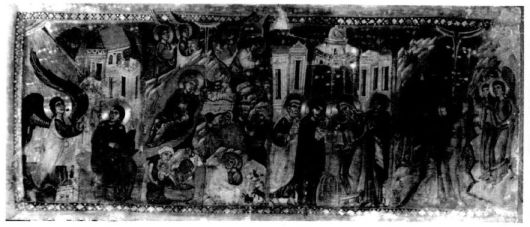
1. The Twelve Feasts. A part of iconostasis beam. The St. Catherine’s Monastery at Mount Sinai. 13th century
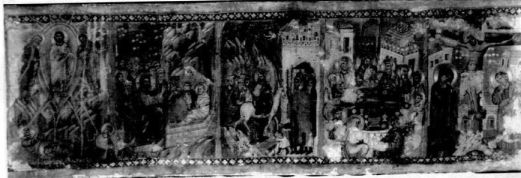
2. The Twelve Feasts. A part of iconostasis beam. The St. Catherine’s Monastery at Mount Sinai. 13th century
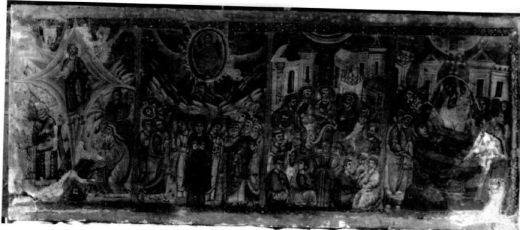
3. The Twelve Feasts. A part of iconostasis beam. The St. Catherine’s Monastery at Mount Sinai. 13th century
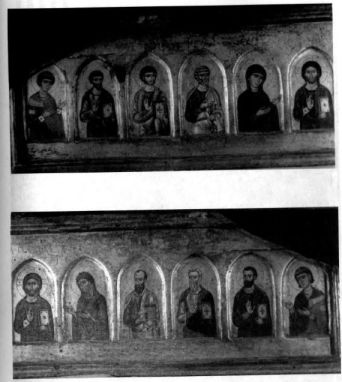
4–5. The Great Deesis. Two parts of iconostasis beam. The St. Catherine’s Monastery at Mount Sinai. 13th century
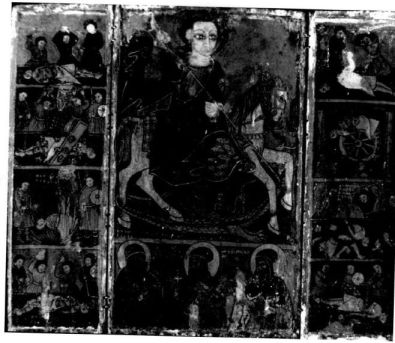
6. St. George with three Ethiopian saints and the St. Gearge Vita cycle. A triptych. Ethiopia. Early 16th century
* * *
Примечания
It is pleasure to acknowledge the support of the Centre for European and Russian Studies at UCLA in enabling me to attend the Symposium on the Iconostasis held in memory of Andre Grabar in Moscow in June 1996. I would also like to thank Elizabeth Teviotdale for her astute comments.
Weitzmann K. Thirteenth-Century Crusader Icons on Mount Sinai // Art Bulletin. 1963. Vol. 45. P. 181–183. Fig. 3–4; Idem. Icon Painting in the Crusader Kingdom // DOP. 1966. Vol. 20. P. 62–64. Fig. 22–23; both reprinted in Studies in the Arts at Mount Sinai (Princeton, 1982); Idem. Icon Programs of the 12th and 13th Centuries at Sinai // DXAE. 1984. T. 12. P. 82–86. Fig. 15–17. For a color reproduction of the Nativity see: Weitzmann K. The Icon. New York, 1982. P. 222–224. See also ibid., 204.
Soteriou G., M. Icônes du Mont Sinaï. Athènes. 1956. Vol. 1. Fig. 117–124: T. 2. P. 112–114; Weitzmann K. Icon... P. 205. 229–231: Idem. Crusader Icons and Maniera Greca // Ed. 1. Hutter. Byzanz und der Westen. Vienna. 1984. P. 158–159. Fig. 22 a–b: Idem. Icon Programs... P. 80–82.
The modification of the panel may be compared to another icon from Sinai, a seventh- century image showing the Virgin and Child (Kiev. Museum of Eastern and Western Art). The upper corners of this panel were cut off at some point, creating a triangular termination. In its present state, thus, the icon has the «Gothic» shape of a panel in an Italian trecento altarpiece. See: Weitzmann K. Monastery of St. Catherine at Mount Sinai // Weitzmann K. et al. The Icons. Princeton, 1976. P. 15–18. plate B 2.
Labrecque-Pervouchine N. L'iconostase: une évolution historique en Russie. Montréal, 1982.
A particularly illustrative example of this type of sanctuary barrier can be found in the Church of St. Panteleimon at Nerezi. On the sanctuary barrier in the Byzantine church see: Chatzidakis M. L'évolution de l’icône aux 11e-13e sièles et la transformation du templon // XVe Congrès International d'études byzantines. Athènes, 1976. Vol. 3. P. 157–192: Walter C. The Origins of the Iconostasis // ECR. 1971. Vol. 3. P. 251–267. reprinted in his Studies in Byzantine Iconography. L., 1977; Mango C. On the History of the Templon and the Martyrion of St. Artemisos at Constantinople // Зоограф. Београд, 1979. T. 10. C. 1–13, reprinted in his Studies on Constantinople. Aldershot, 1993: Epstein A.W. The Middle Byzantine Sanctuary Barrier: Templon or Iconostasis? // JBAA. 1981. 134. P. 1–28: Thon N. Zur Entwicklungs-geschichte der Ikonostase // ZOK. 1986. Vol. 2. P. 193–207 was not accessible to me.
Epstein A.W. Op. cit. P. 26.
The Deesis was shown on the epistyle of the templon in the church of St. Sophia in Constantinople. See: Walter C. Further Notes on the Deesis // REB. 1970. Vol. 28. P. 161–87. reprinted in Studies in Byzantine Iconography. On the epistyle in the main church of the Pantokrator Monastery in Constantinople, the Deesis and the Great Feasts appear to have been combined. See: Epstein A.W. Middle Byzantine Sanctuary Barrier. P. 5: Epstein A.W. Ibid. P. 15 states that six of the eleventh- to thirteenth-century beams at Sinai depict the Deesis.
Walter C. A New Look at the Byzantine Sanctuary Barrier // REB. 1993. Vol. 51. P. 203–228.
Weitzmann K. Thirteenth-Century Crusader Icons // Art Bulletin. 1963. Vol. 45. S. 179–203: Idem. Icon Painting... P. 51–83: Idem. Four Icons on Mount Sinai: New Aspects of Crusader Art // JOB. 1972. Bd. 21. S. 279–93.
Demus O. Zum Werk eines venezianischen Malers auf dem Sinai // Byzanz und der Westens / Ed. I. Hutter. S. 131–142.
Weitzmann K. Icon Programs... P. 82.
Belting H. Likeness and Presence. Chicago, 1994, P. 21.
Gardner J. Altars, Altarpieces, and Art History: Legislation and Usage / Altarpieces. 1250–1550. Function and Design / Ed. E. Borsook. F. Superbi Gioffredi. Oxford, 1994. P. 5–39, esp. 14–15.
A better example with which to examine the relationship between the Byzantine iconostasis beam and the Italian dossal might be the lintel on the east portal of the Pisa Baptistery. This relief appears to be an adaptation of Byzantine models by Pisan craftsmen. See: Kopp-Schmidt G. Die Dekorationen des Ostportales am Pisaner Baptisterium // JBK. 1983. Bd. 34. S. 25–58. esp. 47–51.
Mouriki D. The Icons of the Twelfth to the Fifteenth Centuries // Sinai: Treasures of the Monastery of St. Catherine / Ed. K. Manafis. Athens. 1990. P. 102–124.
Ibid. P. 109.
Weitzmann K. Thirteenth-Century Crusader Icons. P. 182: Idem. Icon Painting. P. 67, referring to misspellings in an icon of St. Procopius.
Examples are some of the inscriptions on the crown of Constantine IX Monomachos in Budapest, or the captions accompanying some of the frescoes found in the churches of Cappadocia. For the crown of Constantine IX see most recently: Oikonomidis N. La couronne dite de Constantin Monomaque // Travaux et Mémoires. 1994. 12. P. 241–262, who uses the misspellings to argue, not entirely convincingly, that the crown is a fake.
Weitzmann K. Icon Painting... P. 63–66: Idem. Icon Programs...P. 84.
Weitzmann K. Thirteenth-Century Crusader Icons. P.183.
Weitzmann K. Crusader Icons and Maniera Greca. P. 158–159; Idem. Icon Programs... P. 81.
Even those currently used as iconostasis beams are not in their original position. See: Weitzmann K. Icon Painting... P. 71. 75.
Lowe E.A. An Unknown Latin Psalter on Mount Sinai // Scriptorium. 1955. T. 9. P. 177–179: Idem. Two Other Unknown Latin Liturgical Fragments on Mount Sinai // Speculum. 1965. Vol. 19. P. 3–25.
Palestine Pilgrims Text Society, The Wanderings of Felix Fabri, II. 1983. Vol. 9–10. P. 547, 612–613. Repr.: New York. 1971.
Pococke R. Description of the East and Some Other Countries. London, 1743. Vol. 1. Pl. 56, between p. 150–151. See also: Skrobucha H. Sinai. London, 1966. P. 78. One piece evidence relating to the Latin-rite chapel in the monastic complex at St Catherinés is provided by: Burckhardt J.L. Travels in Syria and the Holy Land. London, 1823. P. 543, where he claims that he was shown chapels belonging to the Armenians, Copts and Latins, but that they had long be abandoned by their owners. The Latin chapel, it is claimed, fell into ruins at the end of the seventeenth century.
Weitzmann K. Crusader Icons and the Maniera Greca. P. 159.
A problem acknowledged in Weitzmann K. Icon Programs... P. 81.
Eckenstein L. A History of Sinai. London. 1921. P. 146–150; Hobbs J.J. Mount Sinai. Austin, 1995. P. 82.
Skrobucha H. Sinai. P. 78.
Sandoli S. de. Itinera Hierosolymitana Crucesignatorum. Jerusalem, 1983. Vol. III. P. 277.
Rabino H.L. Le monastère de Sainte-Catherine (Mont-Sinai). Souvenirs épigraphiques des anciens pèlerins // Bulletin de la société royale de géographie d'Egypte. 1935. Vol. 19. P. 21–126, esp. 55–65. Fig. 5–9, pl. 15.
Grossman P. Architecture // Sinai, P. 38. See also: Rabino H.L. Le monastère de Sainte-Catherine du Mont Sinaï. Cairo. 1938. P. 54–57.
See footnote 29 and: B. Hamilton. The Latin Church in the Crusader States. London, 1980. P. 169–169, 319–320.
See, for instance: Weitzmann K. Thirteenth-Century Crusader Icons. P. 181; Idem. Icon Programs... P. 65.
Weitzmann K. A Group of Early Twelfth–Century Sinai Icons Attributed to Cyprus // Studies in Memory of David Talbot Rice / Ed. G. Robertson, G. Henderson. Edinburgh, 1975; Mouriki D. Icons of the Twelfth to the Fifteenth Centuries. in Sinai. P. 102–124. For a list of past and present metochia see: Ibid. P. 380.
Weitzmann K. Thirteenth-Century Crusader Icons... P. 183.
Ibid. Idem. Icon Programs... P. 95.
The images currently in place on the epistyle date from the fifteenth century. See: Hager H. Die Anfänge des italienischen Altarbildes. Munich, 1962. S. 69; Walter C. Origins of Iconostasis // ECR. 1971. Vol. 3. P. 258.
Kieslinger F. Le transenne della Basilica di S. Marco del sec. XIII // Ateneo Veneto. 1944. T. 131. P. 57–61.
Braun J. Der christliche Altar in seiner geschichtlichen Entwicklung. Munich, 1924. Bd. 2. S. 649–670; Gamber K. Sancta Sanctorium. Studien zur liturgischen Ausstattung der Kirche, vor allem des Altarraums. Regensburg, 1981. P. 109–119.
Wilkinson J. Jerusalem Pilgrimage... London, 1988. P. 282.
Francis R.B. The Medieval Churches of Cyprus. London, 1949. P. 33.
Buchthal H. Miniature Painting in the Latin Kingdom of Jerusalem. Oxford. 1957. P. 48–49, 51.
Apart from its connections with Venice, the beam is also seen as being related to the double-sided icon of the Crucifixion and Anastasis, one of the very few icons at Sinai, and indeed elsewhere in the Latin East, with Latin inscriptions. This artist is also thought to have come from Venice. See: Demus O. Zum Werk eines venezianischen Malers... S. 131–142.
Pace V. Italy and the Holy Land: Import-Export. 1: The Case of Venice // The Meeting of Two Worlds/Ed. V. Goss. Kalamazoo, 1986. P. 331–345, esp. 333–334.
For the notion of an artistic lingua franca in the Mediterranean of the thirteenth century see: Belting H. Zwischen Gotik und Byzanz: Gedanken zur Geschichte der sachsischen Buchmalerei im 13. Jahrhunderts. 1978. Bd. 41. S. 217–257.
Chojaacki S. Major Themes in Ethiopian Painting. Wiesbaden, 1983. P. 379, 384, 436; Heldman M. African Zion. New Haven; London, 1993. 188–189. Cat. 88: Cormack R. Painting the Soul: Icons. Death Masks and Shrouds. London, 1997. P. 211–213.
Goitein S.D. Mediterranean Society. Berkeley, 1971. Vol. II. P. 296–297.
Musée du Louvre. Catalogue des boiseries de la section islamique. Paris, 1988. Fig. 45, 45a.
Ibid.